
Blog
As of 7 July 2026, Advanced Driver Distraction Warning (ADDW) Becomes Mandatory in All New Vehicles Sold in the European Union
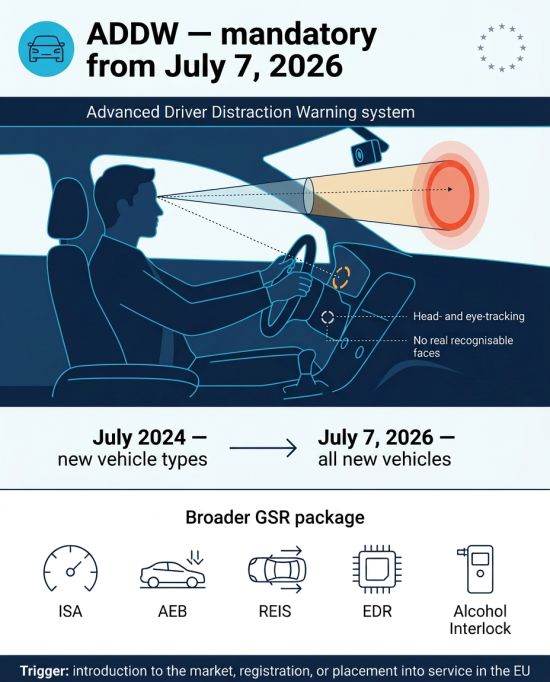
Starting from 7 July 2026, all new vehicles placed on the market, registered or entered into service in the European Union market must be equipped with an Advanced Driver Distraction Warning (ADDW) system. For many drivers, this will simply be another electronic “assistant” designed to detect smartphone use or prolonged periods of looking away from the road. From the perspective of vehicle manufacturers and technology providers, however, this marks a much more significant milestone.
The mandatory implementation of ADDW represents another key step in the rollout of the General Safety Regulation (GSR) while establishing a new benchmark for vehicle design. From now on, vehicle safety will no longer be assessed solely based on what happens outside the vehicle. Equally important is monitoring the behaviour of the person behind the wheel.
From Driver Assistance to Driver Monitoring
Over the past decade, the development of Advanced Driver Assistance Systems (ADAS) has focused primarily on monitoring the vehicle’s surroundings. Sensors have been used to detect lane markings, traffic signs, obstacles and other road users.
As of today, vehicles are also required to monitor the driver. Using an interior-facing camera, the ADDW system analyses eye gaze, head movements and behavioural patterns that may indicate driver distraction. If the system determines that the driver’s attention has been diverted from the road for too long, it issues a warning designed to restore the driver’s focus.
The objective is not to monitor or control the driver, but rather to mitigate one of the most significant risk factors in road traffic: human error.
Why Now?
The new requirement follows the implementation timeline established under the General Safety Regulation (EU) 2019/2144.
- Since July 2024, ADDW has been mandatory for all newly type-approved vehicle models.
- As of 7 July 2026, the requirement applies to every new vehicle placed on the market, registered or entered into service in the European Union market, regardless of when the model was originally developed.
This marks the end of the transitional period and the full implementation of one of the most significant regulatory requirements concerning driver monitoring.
The decisive moment is when the vehicle is placed on the market, registered or entered into service in the European Union, not the date of its production.
ADDW as a Foundation for Higher Levels of Vehicle Automation
Discussions about automated driving often focus on environmental sensors, artificial intelligence and high-definition maps. However, for Level 2 and Level 3 automated vehicles, monitoring the driver’s readiness to resume control is equally critical. This is precisely why ADDW systems are becoming one of the key building blocks for partially automated driving. Without reliable information about the driver’s condition and level of engagement, it is impossible to ensure the safe transfer of control between the human driver and the automated driving system.
The Industry Has Been Preparing for This Moment
Manufacturers of driver monitoring technologies have been preparing for these regulatory changes for several years. In an interview published by Morningstar following the entry into force of the new requirements, Martin Krantz the CEO of Smart Eye, emphasized that the introduction of mandatory ADDW should not be viewed merely as another regulatory obligation. Rather, it reflects the recognition of driver monitoring as one of the fundamental safety features of modern vehicles, comparable to seat belts or the Anti-lock Braking System (ABS).
According to the CEO, data collected by in-cabin cameras will play an increasingly important role in the coming years—not only in preventing collisions but also in enabling intelligent in-cabin functions and supporting higher levels of driving automation.
ADDW Is Only One Element of the New Safety Standard
Mandatory driver attention monitoring is part of a much broader package of safety technologies required under the General Safety Regulation. New vehicles must also be equipped with, among others:
- ISA (Intelligent Speed Assistance),
- AEB (Autonomous Emergency Braking),
- REIS (Reversing Information System),
- EDR (Event Data Recorder),
- Alcohol Interlock Installation Facilitation.
Together, these systems create an environment in which the vehicle not only responds to potential hazards but also actively supports the driver and records critical information during safety-related events.
What does this mean for the market?
The mandatory introduction of ADDW represents far more than another addition to the list of vehicle safety features.
For vehicle manufacturers, it requires the integration of sophisticated in-cabin monitoring technologies into the vehicle’s electronic architecture while ensuring compliance with increasingly stringent type-approval requirements.
For technology suppliers, it creates further momentum for the development of driver behaviour recognition algorithms, computer vision technologies and real-time artificial intelligence.
Today’s milestone clearly demonstrates the direction of European transport policy: the future of road safety will depend not only on monitoring the road ahead, but also on understanding the behaviour of the person behind the wheel.
Source:
- Regulation (EU) 2019/2144 of the European Parliament and of the Council of 27 November 2019 on type-approval requirements for motor vehicles and their trailers, and systems, components and separate technical units intended for such vehicles, as regards their general safety and the protection of vehicle occupants and vulnerable road users.
- Advanced Driver Distraction Warning Systems Now Mandatory Across All New EU Vehicles | Morningstar