
Blog
California closes the “impunity gap” for autonomous vehicles: Key details of AB 1777
The Department of Motor Vehicles of the State of California (DMV) announced on 28 April 2026 the adoption of a regulatory package considered among the most comprehensive frameworks for autonomous vehicle oversight in the United States. The key elements of the package enter into force on 1 July 2026.
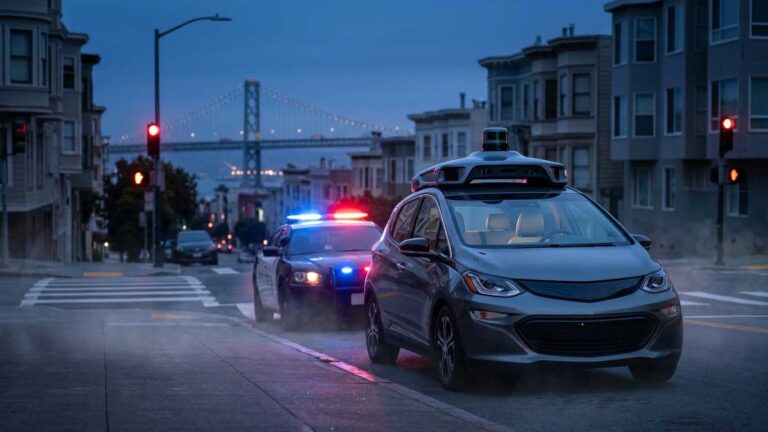
Under the previous legal framework, the addressee of a moving violation notice could only be a natural person operating the vehicle. In the case of fully autonomous vehicles, law enforcement officers were left without a legal basis to enforce traffic regulations, and sanctions were limited to parking citations imposed on the vehicle’s owner. According to data from the City of San Francisco, Waymo’s fleet received 589 parking citations in 2024, totalling USD 65,065.
The direct impetus for the regulatory changes came from two incidents in 2025 in the San Francisco Bay Area. In September, the San Bruno Police Department stopped a Waymo vehicle (Jaguar I-Pace) following an illegal U-turn at a sobriety checkpoint — no citation was issued due to the absence of a human driver. In December, during a power outage affecting approximately 130,000 Pacific Gas and Electric Co. customers, a substantial portion of the roughly 1,000 Waymo robotaxis operating in the city came to a halt at intersections, obstructing traffic and impeding the passage of emergency vehicles. The San Francisco Board of Supervisors had previously documented more than 70 cases of autonomous vehicles interfering with emergency response operations.
Key elements of the DMV package
- Notice of autonomous vehicle noncompliance — an officer issues a formal notice to the manufacturer or fleet operator; the manufacturer must report it to the DMV within 72 hours, and within 24 hours in the event of a collision or injury.
- Transfer of regulatory liability to a legal person — the addressee of traffic regulations becomes the corporate entity operating the vehicle, marking a fundamental departure from the classical model of individual liability.
- 30-second response time for the remote operator — to establish communication with emergency service personnel present at the scene.
- Geofencing of emergency zones — local authorities may designate areas excluding autonomous vehicles during emergency response operations and may order their immediate evacuation.
- Licensing of remote operators — personnel controlling vehicles from the manufacturer’s operations centre must obtain DMV licensing.
- Expanded safety reporting — mandatory reporting of system failures, vehicle immobilisations, hard-braking events, collisions and incidents involving emergency services.
- Administrative sanctions — restrictions on fleet size, operational speed, area of operation or permissible weather conditions; in extreme cases, suspension or revocation of the operating permit.
- Opening of the heavy autonomous vehicle market — the previous prohibition on the operation of autonomous vehicles exceeding 10,001 lbs (approx. 4,536 kg) is lifted; passenger vehicles up to 14,001 lbs (approx. 6,350 kg) may be operated by public entities and universities.
In the United States, Arizona was the pioneer in transferring liability to fleet operators, treating the operator as the driver under the traffic code in the absence of a human in the vehicle. Texas is introducing an analogous regime as of 28 May 2026. At the federal level, there is no uniform statute governing the liability of autonomous vehicles.
In Poland and in most European Union Member States, the classical model of regulatory liability remains in force, under which the natural person operating the vehicle bears responsibility for traffic violations. SAE Level 4 and Level 5 vehicles have not been admitted to regular road traffic; testing is conducted under the Road Traffic Act in a pilot regime, under continuous human supervision. The approach adopted by the State of California — transferring regulatory liability from the natural person to the legal person operating the fleet — may, in the coming years, serve as a point of reference for legislative work at the European Union level and in individual Member States
Sources:
- New Autonomous Vehicle Regulations Strengthen Oversight and Enforcement, Authorize Trucks and Transit — California DMV, 28.04.2026, https://www.dmv.ca.gov/portal/news-and-media/new-autonomous-vehicle-regulations-strengthen-oversight-and-enforcement-authorize-trucks-and-transit/
- California Adopts New Rules Allowing Manufacturers to Test and Deploy Heavy-Duty Autonomous Vehicles — Reuters / U.S. News, 28.04.2026, https://www.usnews.com/news/top-news/articles/2026-04-28/california-adopts-new-rules-allowing-manufacturers-to-test-and-deploy-heavy-duty-autonomous-vehicles
- Driverless cars in California can now get traffic tickets under new DMV rules — CBS San Francisco, 29.04.2026, https://www.cbsnews.com/sanfrancisco/news/driverless-car-traffic-tickets-california-new-dmv-rules/
- Confused Waymo vehicles blocked roads during San Francisco power outage — Associated Press / Police1, 23.12.2025, https://www.police1.com/traffic-safety/confused-waymo-vehicles-blocked-roads-during-san-francisco-power-outage