
Blog
Robotaxis Enter Europe: Uber and Pony.ai Expand Fleet, Waymo Chooses Munich
In August 2026, the European autonomous taxi market entered a new phase. On August 14, Uber and the Chinese company Pony.ai announced an expanded partnership involving the deployment of more than 2,000 robotaxis across five European cities, and on August 25 the American company Waymo announced that it had selected Munich as its first market in the European Union. The two announcements, made barely a dozen days apart, illustrate the accelerating pace of autonomous driving commercialization on the continent.
On August 14, 2026, Uber Technologies and Pony AI Inc., a company listed on Nasdaq and the Hong Kong Stock Exchange, announced an expansion of their multi-year cooperation. The existing robotaxi service, which has been operating since spring 2026 exclusively in Zagreb, is to eventually cover four additional European cities, with the combined fleet exceeding 2,000 vehicles. The companies have not yet disclosed the names of the new cities or a detailed deployment schedule, stating that information will be released in stages.
The cooperation model combines three elements: Pony.ai’s Level 4 (L4) autonomous driving technology, Uber’s global mobility platform handling bookings, payments and customer service, and local operators responsible for the day-to-day management of the fleet. In Zagreb, the role of local vehicle owner and operator is performed by the Croatian company Verne. Pony.ai already runs commercial driverless robotaxi services in four Chinese metropolises, and by mid-2026 its robotaxi fleet numbered close to 2,000 vehicles, with robotaxi service revenue growing by more than 500 percent year over year.
Dr. James Peng, founder and CEO of Pony.ai, stated in the press release that the expanded agreement with Uber marks a new stage in the two companies’ cooperation, reflecting their shared commitment to bringing robotaxis to further European cities. The companies’ partnership dates back to May 2025, when they announced plans to bring Pony.ai robotaxis onto the Uber platform in international markets. The expanded agreement also includes plans for deployments in the Middle East.
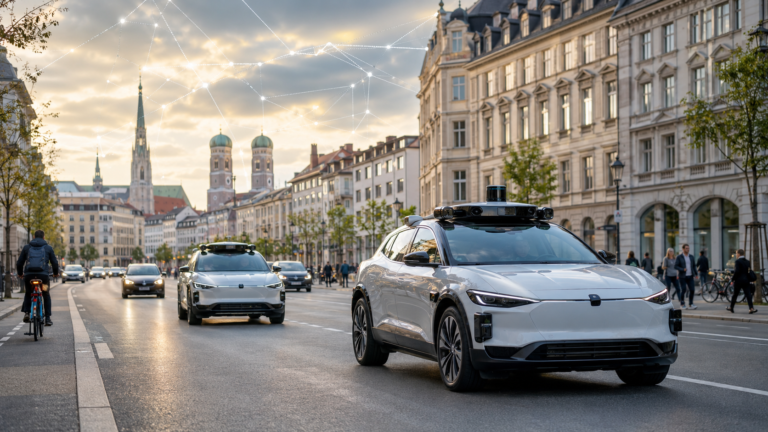
Less than two weeks later, on August 25, Waymo — an Alphabet subsidiary — formally joined the competition on the European market. The company announced on its blog that it is beginning preparations to launch a fully autonomous ride service in Munich — Waymo’s first market in the European Union and its third outside the United States (after London and Tokyo). In the coming weeks, Waymo vehicles will appear on the city’s streets, initially driven manually by trained operators who will create detailed maps of the road network and calibrate the driving system to local traffic conditions. Commercial rides for residents are expected to launch by the end of 2027, subject to approvals from Germany’s federal road transport authority and from Bavarian and municipal authorities.
Waymo reported that it has so far completed more than 20 million rides in the United States and driven autonomously for more than 350 million kilometers. The choice of Munich was commented on by Bavarian officials — Economy Minister Hubert Aiwanger called it a “milestone,” while Christian Hirte, State Secretary at the Federal Ministry of Transport, stressed that autonomous driving will shape the future of mobility.
Both announcements form part of a clearly accelerating trend in the commercialization of autonomous driving in Europe in 2026. In addition to Uber/Pony.ai and Waymo, Baidu (in partnership with the Lyft platform) and WeRide have also announced plans to enter the market; WeRide, together with Uber, plans to launch the first robotaxi service in Spain, in Madrid. Uber is also simultaneously pursuing projects in Munich (with the Israeli company Autobrains) and in Tokyo. European carmakers — Mercedes-Benz, BMW and Volkswagen — are developing their own autonomous driving technologies, driven in part by the need to address driver shortages and by synergies with electric vehicle architecture.
The sector’s growth is also being driven by advancing regulatory harmonization: in June 2026, transport ministers from eighteen European countries signed a joint declaration supporting large-scale cross-border testing of autonomous vehicles, and the European Commission allocated €20 million under the Connecting Europe Facility program for digital infrastructure supporting such testing. Nevertheless, industry analysts note that the pace of deployment in Europe remains constrained by fragmented national regulations, safety requirements that are more stringent than in the US or China, and a still-cautious public attitude toward driverless vehicles.
Sources:
- „Pony.ai and Uber Expand Partnership to Deploy Over 2,000 Robotaxis in Europe”, komunikat prasowy Pony AI Inc. / Uber Technologies (Business Wire), 14 sierpnia 2026, https://investor.uber.com/news-events/news/press-release-details/2026/Pony-ai-and-Uber-Expand-Partnership-to-Deploy-Over-2000-Robotaxis-in-Europe/default.aspx
- Kirsten Korosec, „Uber and Pony.ai plan to bring 2,000 robotaxis to Europe”, TechCrunch, 14 sierpnia 2026, https://techcrunch.com/2026/08/14/uber-and-pony-ai-plan-to-bring-2000-robotaxis-to-europe/
- „Uber partners with China’s Pony.ai for 2,000 robotaxis in Europe”, CNBC, 14 sierpnia 2026, https://www.cnbc.com/2026/08/14/uber-partners-with-chinas-ponyai-for-2000-robotaxis-in-europe.html
- „Servus München: Waymo is Coming to Germany”, oficjalny blog Waymo, 25 sierpnia 2026, https://waymo.com/blog/2026/08/waymo-in-munich/
- „After Uber, Waymo to launch the EU’s first robotaxis in Munich”, Euronews, 26 sierpnia 2026, https://www.euronews.com/business/2026/08/26/after-uber-waymo-to-launch-the-eus-first-robotaxis-in-munich
- „Waymo confirms Munich as its first mainland Europe market”, Automotive World, 26 sierpnia 2026, https://www.automotiveworld.com/news/waymo-confirms-munich-as-its-first-mainland-europe-market/