
Blog
China: Mandatory Physical Buttons and MRM Maneuvers
In mid-February 2026, China’s automotive market regulator – the Ministry of Industry and Information Technology (MIIT) – announced the introduction of a package of new technical standards redefining the approach to safety in Intelligent Connected Vehicles (ICV). These documents, officially published on February 15, 2026, on the government portal miit.gov.cn, constitute a direct response by the state administration to a series of incidents that revealed loopholes in existing homologation procedures. An analysis of the content of the new guidelines, conducted based on reports from the Xinhua agency and industry portals Automotive News China and CnEVPost, indicates a departure from the uncritical digitalization of cockpits in favor of hybrid solutions that guarantee physical safety.
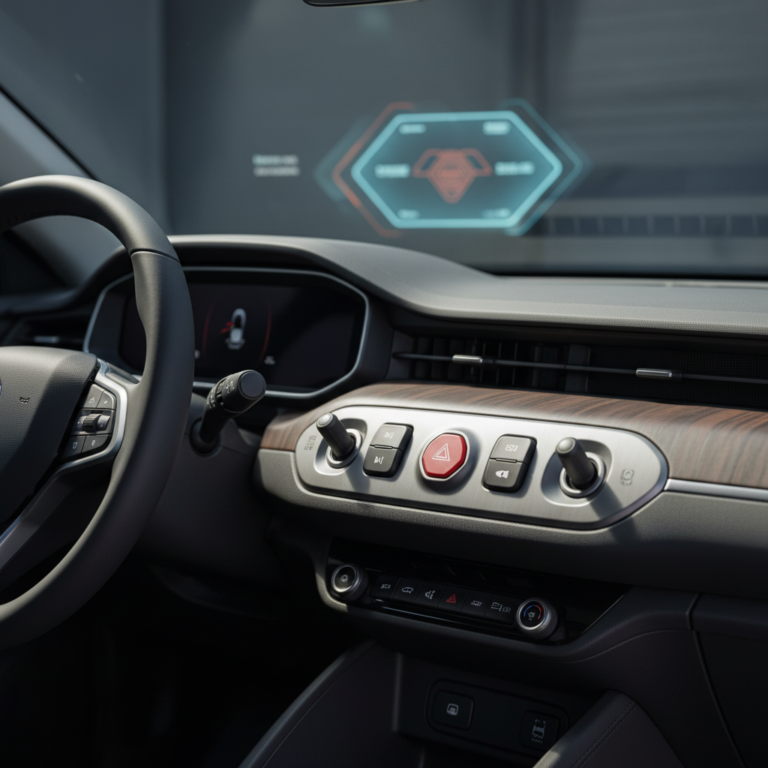
The first key area of regulation is the restoration of physical control interfaces. According to the document titled “Technical Requirements for Human-Machine Interaction Safety in Passenger Vehicles (Draft for Implementation 2027)”, manufacturers have been obliged to equip new models with durable, mechanical buttons or levers for safety-critical functions. This regulation explicitly lists: turn signals, hazard lights, windshield wipers, and the e-Call system. As reported by CarNewsChina in its analysis on February 16, this marks the end of the minimalist trend previously promoted by brands such as Tesla and new Chinese EV players. The MIIT’s justification relies on safety reports demonstrating that operating touchscreens in stressful situations extends driver reaction time to a degree that threatens road safety.
The second, and from the perspective of transport automation most significant pillar of the new regulations, is the drastic tightening of requirements for vehicles equipped with Level 3 and Level 4 automated systems. This change is a direct result of the analysis of the incident in Zhejiang province (widely known as the “Wang case”), where a vehicle with an active assistance system, upon detecting a lack of response from the sleeping driver, executed an emergency procedure consisting of simply stopping in the traffic lane. Such behavior, although technically correct under old regulations, led to the creation of congestion and a real threat of a pile-up on the highway. In response to this specific case, the MIIT, in the updated document “Guiding Opinions on Strengthening the Management of Intelligent Connected Vehicle Production Access”, introduced a mandatory requirement for the implementation of advanced “Minimum Risk Maneuver” (MRM) procedures. The new standard stipulates that in the event of a system failure or lack of driver response, the vehicle has no right to stop in the path of travel. The autonomous system must possess sufficient redundancy and computing capability to safely change lanes, pull over to the shoulder or an emergency bay, and only there terminate the operation.
This requirement raises the technological bar significantly higher, eliminating from the market systems “pretending” to be autonomous that cannot cope with dynamic environmental changes in emergency mode. According to information provided by Automotive News China, these regulations enter into force with a one-year transition period, compelling many manufacturers to urgently update software and hardware architecture in upcoming models for 2027. Source documents, including the full texts of draft regulations (GB Standards drafts), are available in the MIIT legislative database and were widely commented on in the Xinhua news agency bulletin dated February 15, 2026, titled “Ministry of Industry and Information Technology issues new technical guidelines for intelligent connected vehicle cockpit safety”.
Summary and Implications
The decisions by MIIT in February 2026 are of a regulatory nature in the Chinese automotive sector. By linking conclusions from judicial case law (the criminal case of Wang) with hard technical requirements (the MRM requirement and physical buttons), China is creating a coherent legal-technical ecosystem. For global automotive corporations, this implies the necessity to adapt their flagship products to new, more rigorous standards, which – as predicted by experts cited by CnEVPost – may soon become a reference point for regulators in Europe (UNECE) and the United States (NHTSA) as well.